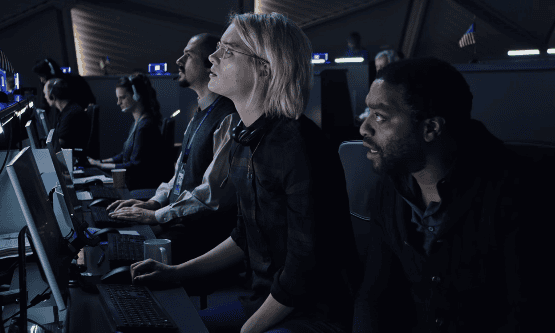
EX MACHINA: A SMALL FILM WITH BIG IDEAS

Ex Machina marks the directorial debut of Alex Garland who wrote amongst others Dredd, 28 Days Later and Sunshine. It is a solid and confident effort that impresses less with big sequences but more with elegantly articulated big ideas and uneasy answers. It is old school science fiction released for a new age.

The premise is Caleb Smith (Domhnall Gleeson) a programmer at a tech company has won a competition to go and meet with the CEO of the company at his secluded retreat to hang out for a week. There is suitable build up to this with the retreat being remote and isolated and Gleeson having to make the last part of his journey by foot. The CEO Nathan Bateman as played by Oscar Isaac is introduced working out before grabbing a beer and speaking like a friendly college frat boy while still pulling power dynamics wherever he can. Nathan informs Caleb he has nominated him to interact with an artificial intelligence android that Bateman has built to see whether it has become a fully sentient being. He is to interview the android named Ava portrayed by Alicia Vikander daily while she remains in it’s room at all times over the course of the week and report back to Bateman each night to see what they think. The only other character present is Kyoko (Sonoya Mizuno) who is Nathan’s housemaid.

How each audience member reacts to each character may say as much about themselves as it does about the characters and certainly one of the pleasures of the film is seeing these very different creatures bounce off each other. The movie enjoys playing with the ideas of who is being tested, is anybody else maybe a robot, who is sympathetic or being dishonest and just where this all may lead? I wouldn’t dare spoil it, it is nice to not be sure of a film’s outcome and yet also at the end be satisfied with it. To create this balancing act you need good performances and Ex Machina has some of the most exciting young actors working today. Domhnall Gleeson as the lead and audience surrogate should conventionally have the least to hide but he gives many layers to his character. Oscar Isaac plays the alpha male here with coiled aggression and relaxed dominance but as the film goes on we see more and more this may be a mask. Alicia Vikander, with this the first of three films for her break out year of 2015 is great, is unnervingly disquieting at times and at others naïve and vulnerable. Sonoya Mizuno given the least to do is mostly a mute performance having to convey character through physicality which she does effortlessly (I’m not surprised to discover she is a Royal Ballet School graduate), one of those performances that can be underappreciated but with which the whole film would’ve suffered if she hadn’t delivered.

Set in and around the retreat for the most part with a small cast the film makes a mark with the minimalist architecture of the location clashing strongly with the imposing natural landscape. The understated and cold nature of the text is echoed in this design and also in the score by Ben Salisbury and Geoff Barrow. The design of Ava is quite compelling incorporating transparent machine parts replicating human organs, coupled with body parts often sexualised coated in rubber and then topped off with the doe eyes of Vikander. This is a design meant to confront your own ideas about gender, sexuality and what it is to be human or machine. All the effects were created in post-production with scenes being shot twice (once with Vikander and once without) to capture the background as well. For the machine parts Vikander’s body was rotoscopped out but to retain her movement camera tracking systems taken of Vikander were transferred in. Close to half of the effect shots are in service to Ava’s presence, think about that for a second, half of the effect shots for the film are in service to a character.

Apparently Garland worked hard to keep the script low key so that the budget would remain small and he could retain creative control without having to throw in a third act action sequence. That is not to say the third act isn’t exciting, the whole film is a build up to it and it’s gripping as these characters finally reveal what they’re truly capable of while coming to a head. They should make more movies like this.

-Lloyd Marken

THE MARTIAN BRINGS MATT DAMON HOME TO BLOCKBUSTER STARDOM


A man wakes up marooned on a desert planet with his chest punctured. He gets up and staggers back to his lab, slow in his pace in pain and fatigued. Wounded and alone in the lab he must administer first aid to himself. There is no one to talk to and no time to think. He must either treat himself or he will die. There is no question in that moment about the futility of his survival and the challenges he will face if he is successful. There is only an immediate and inevitable task to complete to survive. No life flashing before his eyes. No admonishments of a crew that have abandoned him or questioning of his own decisions that put him in such a dire situation.

The whole scene is a microcosm of the film at large which is always first and foremost focussed on the survival of Mark Watney, the astronaut stranded on Mars after an emergency take off, played by Matt Damon. In earlier decades the role may have gone to Harrison Ford or Jimmy Stewart, movie stars that audiences easily relate to as one of them and actors whose greatest strength are underplaying the scene the more extraordinary the circumstances. If one is not a fan of Damon you can move on, I highly recommend for example checking out Mad Max on DVD this week but for the majority of the population this may be the best sci-fi film in years. Speaking of, Matt Damon and Ridley Scott need to buy screen writer Drew Goddard a drink and make it a double because he has made their best film each respectively in over a decade. Matchstick Men was the last time Sir Ridley scored this high and not counting the numerous Matt Damon supporting roles in films and indie hits this is his best blockbuster since The Bourne Supremacy, sorry people The Bourne Ultimatum is just a remake of Supremacy with diminishing returns.

Where Goddard has gone right adapting from an original novel is where so much other recent output has gone wrong. In short the film’s greatest strength is its lack of ambition. No navel gazing here. Mark does not have a family waiting for him at home that he desperately misses, he just wants to live. There are no political allegories about rich and poor, ideologies, immigration, etc. No great questions about what Mars exploration could mean for our society and our place in the universe. At times Watney lies under his Rover in the Red Dirt and we may ponder how extraordinary it would be to live on another planet but while the camera takes in the locations it does not dwell on them. The film looks great but there is a businesslike approach to the shots of orientation not infatuation which coming from such a great visual stylist as Sir Ridley is a surprise but not a disappointment.

Beneath the surface are a few points being made? The reaction of some at NASA to find him alive is to begin a dialogue about how this should be handled in the media but these seem like inevitable conversations that would take place between people who’s priorities are complex.

movie animated GIF

At first the scenes on Mars are far more interesting. Watney’s plight is dire and daunting and yet the film has a cheeky sense of humour about it. See Damon deadpan about a failed experiment to camera after he blows himself up. As Watney finds a way to communicate with NASA his rescue and the film grow momentum. The people at NASA become warmer and their story more humorous by interacting with Watney. As Watney comes up with an ingenious way to grow potatoes so too do engineers back home have to problem solve a way to rescue him and their numbers grow with more offbeat characters. A sole human stranded and isolated on Mars humanises a group of bureaucrats sitting comfortably back home on Earth via increased contact with him. I don’t think this is unplanned by the filmmakers.

Sound also plays an important part in the film, I can’t guarantee it 100% but I don’t recall any military drums building in the background as people declare they will bring ‘our’ boy home. It is not only Damon underplaying here. Silence is used a lot to reflect the vacuum of space and moments of tension. We are as focussed for example on air escaping through broken visors and alarms sounding as Watney is, sometimes more. The score is non-demonstrative and the music that makes itself far more known is the 70s hits that Watney is forced to listen to for comfort as it is the only music on the planet. That cheeky humour comes through in the song choices here too. As Watney prepares for his rescue ABBA’s Waterloo comes on reflecting both Watney’s attitude towards the plan but also playing against audience expectations

.

A film about a stranded astronaut rife with 70s tracks demands a track from Bowie to be used and The Martian answers the call better than I could have hoped. The choice of Major Tom would have been welcome if too on the nose. Instead Starman begins right where it needs to in arguably the best moments of the film. The crew who left Watney behind circle around Earth to pick up supplies and sling shot back towards him. This enables the crew to communicate with families hundreds of miles away from them but as close as they have been in months before returning to rescue their stranded crew member. It is a heroic gesture full of sacrifice but the film plays the scene as one of unbridled joy. “Whoever saves one life, saves the world entire.

This is one of the year’s best.